Tuesday, November 21, 2006

Here we go again...

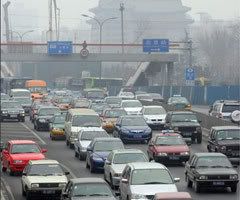
BEIJING (Reuters) - Air pollution in Beijing, under pressure to provide clear skies before the 2008 Olympics, reached the worst level on a government air quality index on Tuesday.

Beijing's air pollution was rated "hazardous" -- the highest category in the China Environmental Monitoring Center's index -- for the 24-hour period ending at noon on Tuesday, Xinhua said.

For a second consecutive day, Beijing was blanketed in heavy fog, which reduced visibility to a few hundred metres, and had delayed at least 80 flights, the official Xinhua news agency reported.

The capital's worsening pollution comes as China's environmental watchdog reported on Tuesday that national industrial emissions continued to soar in the first nine months of 2006.

Beijing has pledged to cut air pollution in the lead-up to the Olympics but faces an uphill battle as its increasingly wealthy population rushes to buy exhaust-emitting cars.

From July to September, one out of every three days were classified as polluted in Beijing and 15 other major cities and had affected the "physical" and "psychological health" of some 15 million people, the State Environmental Protection Agency said on its Web site.


Pollution is really a huge problem in China... Beijing is one of the most polluted cities in the world. Looks like this is the biggest challenge for the success of the Games in Beijing 2008 will continue to be air pollution!

Labels:


Friday, November 17, 2006

A Clean Beijing

"(BEIJING, Nov. 16) -- Beijing has already achieved its goal of using clean energy in the heating system for the year.

Up to the end of October, a total of 1410 boilers with a combined capacity of 5,000 tons have been converted to clean energy, fulfilling the plan for the year two months ahead of schedule.

Since 1998, the capital city has devoted attention to combating air pollution, with the use of clean energy instead of coal as a major priority. Over the past several years, more than 10,000 boilers with a capacity of less than 20 tons each and 44,000 tea boilers have taken in clean energy. As a result, the annual average of sulfur dioxide in the atmosphere fell to 50 micrograms per cubic meter in Beijing in 2005, which means the national standard was met.

In its 11th five-year plan for the national economic development (2006-2011) Beijing has pledged to continue upgrade the rest of 2800 boilers with a capacity of less than 20 tons each."


This report is ambiguous. Anyone knows what is the clean substitute for coal that they use? What's tea boilers?

Labels:


Read More

Friday, November 10, 2006

Beijing 2008 Gets “Green” Certification

"Posted 11:54 am ET (GamesBids.com)

The Beijing Organizing Committee for the 2008 Summer Olympic Games has passed its environmental management system (EMS) and is accredited with a re-certified ISO14001 by China’s Environmental Certification Center.

The certification covers twelve areas including BOCOG Green Office, event route planning, communications, accommodation, catering and Games-time transportation service, marketing, Olympic procurement, organization of large scale activities, torch relay route planning, venue planning and construction, and environmental management. "


The only question I have is whether the Chinese National certification is comparable to an International one.

Labels:


Read More

Wednesday, November 01, 2006

One Last Article on the Pollution Trilogy

Satellite data reveals Beijing as air pollution capital of world

Jonathan Watts in Beijing
Monday October 31, 2005
The Guardian

As it gears up to host the 2008 Olympic Games Beijing has been awarded an unwelcome new accolade: the air pollution capital of the world.
Satellite data has revealed that the city is one of the worst environmental victims of China's spectacular economic growth, which has brought with it air pollution levels that are blamed for more than 400,000 premature deaths a year.

According to the European Space Agency, Beijing and its neighbouring north-east Chinese provinces have the planet's worst levels of nitrogen dioxide, which can cause fatal damage to the lungs.

An explosive increase in car ownership is blamed for a sharp rise in unhealthy emissions. In the past five years the number of vehicles clogging the capital's streets has more than doubled to nearly 2.5m. It is expected to top the 3m mark by the start of the Olympics in 2008.
Alarm about the perilous state of the environment has gathered pace in recent years. China is the world's second-largest producer of greenhouse gases, and the World Bank has warned it is home to 16 of the planet's 20 most air-polluted cities.

According to the European satellite data, pollutants in the sky over China have increased by about 50% during the past 10 years. Senior officials warn that worse is still to come. At a recent seminar Zhang Lijun, deputy director of the environmental protection agency, said that pollution levels could more than quadruple within 15 years unless the country can slow the rise in energy consumption and automobile use.

A recently published study, conducted by the Chinese Academy on Environmental Planning, blamed air pollution for 411,000 premature deaths - mostly from lung and heart-related diseases - in 2003. It said that a third of China's urban residents were exposed to harmful levels of pollution. More than 100 million people live in cities, such as Beijing, where the air is considered "very dangerous".

The political implications are also becoming more apparent. Health concerns, particularly regarding cancer and birth defects thought to be caused by chemical factories, have been a major factor in a recent wave of protests. Conservation groups say acid rain falls on a third of China's territory and 70% of rivers and lakes are so full of toxins they can no longer be used for drinking water.

Labels:


Another way to improve traffic

Beijing is fully confident about providing sound transport for the 2008 Olympic Games, a top municipal traffic management official said here on December 10, 2004.

Vice Director of the Beijing Municipal Committee of Communication (BMCC) Liu Xiaoming told a press conference held at the Olympic Press Center that the city authorities has adopted measures to address traffic problems by stepping up infrastructure construction and developing public transport.

Liu said the total number of automobiles in Beijing has reached 2.27 million, and that the number is still growing as citizens buy more new cars this year. However, traffic mobility on main roads within the Fourth Ring Road had improved by up to 15 percent so far this year, Liu said.

Liu said in order to ease traffic congestions, the city has started 101 construction projects this year, including 43 new roads, 35 trunk roads, three highways and 20 road renovations. The total length of the newly built road will reach 102.6 kilometers. So far 11 of the construction projects have been completed and five are expected to be open to traffic at the end of the year. Liu said the construction of 32 roads and 11 clover-leaf bridges are currently under way in such areas as the Olympic Park area.

Since infrastructure construction takes a relatively longer time, the city authorities has optimized traffic control at 100 junctions and stepped up supervision along hazardous sections of roads. As a result, the number of traffic accidents have declined by 50 percent over the last year, Liu said.

More than 60 Chinese and international media members attended the press conference, which is presided by Director of the Olympic Press Center Wang Hui.

... but not air quality for sure.

Labels:


Car Free Day

Photobucket - Video and Image Hosting
"BEIJING : Hundreds of thousands of drivers have heeded official calls to stay off Beijing's busy streets for a high-profile summit in what is seen as a rehearsal of 2008 Olympic traffic-control efforts.

Traffic was lighter than normal in this city of 15 million notorious for its traffic jams on Wednesday, as a six-day ban on most government vehicles taking to the road got underway.

At least 490,000 vehicles from the government's fleet stayed in the garage, according to the Beijing Traffic Management Bureau.

At least 250,000 private drivers also heeded the call, aimed at preventing delegates here for a China-Africa Cooperation Forum summit from getting ensnared in traffic, state media said.

Members of hundreds of motor clubs in the Beijing area pledged to stay off the road or minimise their driving during the summit, the Beijing Daily reported.

Fast-modernising Beijing has nearly three million registered motor vehicles, including nearly two million private cars, and the number is increasing by more than 1,100 a day, state media reported last month.

The official Xinhua news agency described traffic in Beijing as at "crisis point".

China, which has been on a recent drive to increase its influence in Africa and its access to the continent's energy resources, is pulling out all the stops to impress delegations from 48 African nations for this weekend's summit.

Huge banners and billboards emphasising Sino-African friendship have been put up around the city for what the Chinese media have hailed as the highest-profile international gathering in China since 1949.

But the Beijing Daily also said this week's traffic measures were a "high-level rehearsal for the Olympic Games".

The measures also include a ban on taxis using the expressway linking the city with its airport.

Chinese authorities have said previously they intend to take short-term measures during the Olympics to ensure the roads are not congested while the Olympic spotlight shines on the city.

Beijing has hinted it may ban some cars from the streets and ration petrol.

A senior official with the Beijing Olympic Organizing Committee told reporters last week the city was considering establishing special Olympic traffic lanes and encouraging people to use public transport.

- AFP/ms"


Let's do the maths. It's 645 days to the Olympics. Assuming the number of cars increase at a constant pace, then we will have: 3 million + (1100 * 645) = 3.709 million cars. That's a 24% increase.

How are they going to keep to a Green Olympics?

Labels: ,